
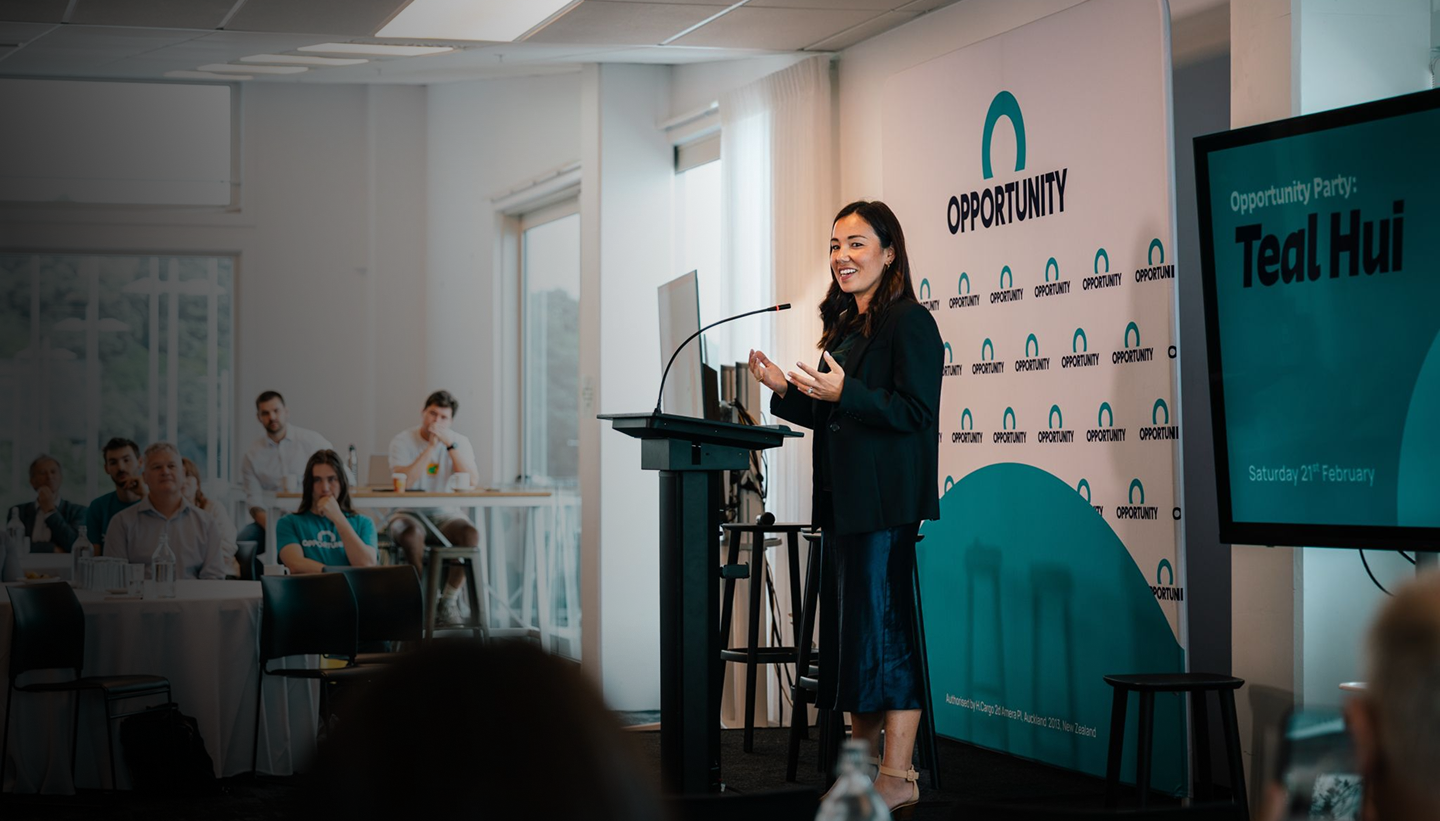

The State of the Nation speech
In her State of the Nation speech, Qiulae paints a vivid picture of New Zealand in 2050: a country where people can afford to live well, nature has made a comeback, and the next generation is excited about building things rather than just owning property.
In 2013, I was fortunate to travel to China for the first time with my siblings, our cousins and aunts and uncles.
It was a pilgrimage of sorts. To visit the villages that my Chinese grandparents left behind in the 40s when they went to build a new life in Fiji. A safer life, a life of more opportunity for them and their children.
At my grandmother’s childhood home, everyone was gathering around a small, very nondescript concrete hole in the back courtyard.
Turns out it was a well. A well that my grandmother hid in as a young girl during the war when the Japanese were invading, looking for women and girls to take captive.
It was pretty harrowing to think of her at such a young age, bravely sheltering there for days.
It was one of those moments in life, when you suddenly see the thread that ties you to your ancestors. The butterfly effect of moments and decisions that lead to your life today.
I think about all the opportunities I’ve had in my life – my safe and happy childhood growing up next to One Tree Hill – thanks to her bravery and the subsequent decision she and my grandfather made to start a new life in Fiji.
I think about that ancestral thread – now that I have my own kids – and wonder, what decisions will I make in my life that will better theirs?
In 2050, my daughter Malia will be 30 and Cleo will be 26.
As they step into adulthood – amidst all the love and heartbreak, wins and setbacks that come with it – this is the kind of New Zealand I hope my choices create for them.
In 2050, my daughter Malia will be 30 and Cleo will be 26.
As they step into adulthood – amidst all the love and heartbreak, wins and setbacks that come with it – this is the kind of New Zealand I hope my choices create for them.
By 2050, New Zealand is world-renowned as a place where innovation – combined with a deep care for people and nature – drives a high-value economy and a high quality of life.
Malia lives in a modest, but high-spec, energy-efficient apartment in a vibrant city-fringe suburb. It’s a cooperative housing project where residents contribute to a shared community garden providing cheap, healthy kai and strengthening connections between neighbours.
By mid-century, New Zealand cities have finally grown up and broken the false choice between density and liveability. They are more compact – but also greener and more human.
Gone is the quarter acre dream. Now it’s the quarter – hour – paradise. No matter where you live, it’s only 15 minutes on reliable public transport to work, friends’ houses, nature trails, and bustling night life.
Malia barely thinks about the increase or decrease in the value of her home.
She does not obsess about property in the same way my generation did.
Instead, she talks with her friends about what businesses they might build, what technologies they might pioneer, and what problems they might solve.
Their Sharesies accounts – which they started investing in early with modest amounts – have grown thanks to the success of renewable energy projects and innovative local companies that are excelling on the world stage.
My younger daughter Cleo, at 26, is about to move to Taranaki to work as a Clean Energy Diplomat for the Pacific. Because New Zealand mastered abundant, affordable energy systems in the 2030s, places like Taranaki are now hubs from which virtual training and advice is rolled out to our Pacific neighbours to further strengthen the resilience of the region.
Living outside our largest cities is seen as a great opportunity for young people like Cleo – combining professional ambition with lifestyle and community connection. Our regions are places where traditional industries like farming and forestry are hotbeds of innovation and work harmoniously with nature restoration and tourism.
In 2050, Malia and Cleo listen to tui, kererū, kākā, and kōkako as they walk to work, because predator eradication in the 2040s and the greening of our cities brought the birds back.
It’s a place where they can swim in any river and gather kai moana on any coastline, because of decades of effort by communities, iwi, and government.
It’s a place where they walk through thriving ngahere, because we committed to reforestation projects like Recloaking Papatūānuku. As a result, carbon drawdown through native forests and wetlands have become one of New Zealand’s most effective climate responses – pleasing both Greenpeace and Treasury.
Most importantly, in 2050, Malia and Cleo live in a far less divided New Zealand.
It is not all kumbaya – leaders still debate about the ways through our challenges. But political news clips are now less focused on finger pointing and outrage, and more on respectful dialogue of the issues.
Politicians actually compete for who is better at finding common ground and pragmatic solutions that work for the greatest number of people.
We are 20 years into the landmark hundred-year infrastructure plan that Parliament agreed on in 2030. The government of the day still adds their own flavour to the delivery of those projects, but the overall direction stays the course.
And when politicians refuse to come to the table and work together, we bring everyday Kiwis into the conversation through citizens assemblies to break the gridlock.
This is the New Zealand Malia, Cleo and the next generation of Kiwis deserve to inherit from us.
But – that future feels very much like an out-of-reach utopia.
A few weeks ago, Canada’s Prime Minister Mark Carney delivered a history defining speech. In it, he said - “the old order of the world is gone. We should not mourn it. Nostalgia is not a strategy.”
He’s right. Here in NZ, we are stagnating while the world – changes rapidly – around us. And if we are standing still, then in reality we are going backwards.
A few weeks ago, Canada’s Prime Minister Mark Carney delivered a history defining speech. In it, he said - “the old order of the world is gone. We should not mourn it. Nostalgia is not a strategy.”
He’s right. Here in NZ, we are stagnating while the world – changes rapidly – around us. And if we are standing still, then in reality we are going backwards.
To build the New Zealand we owe the next generation, we have to stop pretending that tweaks and managed decline are an acceptable response to the great challenges ahead of us. To fulfil our obligation to tomorrow, we must – act – today.
And that action starts with honesty on 3 important things our politics, our economy, and our relationship with nature.
First, we need to stop pretending that our politics is fit-for-purpose.
The next generation needs leaders who won’t flip-flop on critical policy every three years, or kick our slow-burn crises down the road again – and again.
When successive governments focus their time on cancelling ferries or rewriting policy with slightly different language, they are wasting our time and our money.
When successive governments focus their time on cancelling ferries or rewriting policy with slightly different language, they are wasting our time and our money.
The next generation needs leaders who respect Te Tiriti for what it is – a gift from our past to our present and future. And an opportunity to build genuine partnership between all the people who call this place home.
The next generation needs leaders who behave with integrity, not schoolyard bullies who divide us to score a vote.
The next generation needs leaders who behave with integrity, not schoolyard bullies who divide us to score a vote.
When New Zealand First tells you that immigrants, transgender Kiwis or environmentalists are the problem – it is New Zealand First’s policies of fear and division that are causing us harm.
So what will Opportunity do differently?
Amidst a broken political system that is failing us, I want to say this loudly – and – clearly.
So what will Opportunity do differently?
Amidst a broken political system that is failing us, I want to say this loudly – and – clearly.
Opportunity will send a new generation of politicians to Wellington.
And we are going to bring a few things with us.
Free of the ideological and party baggage of established politicians, we’ll bring evidence-backed policies to Parliament.
We’ll bring integrity and honesty. We’ll be clear with Kiwis about complex issues and the trade-offs - because New Zealand can’t build a land of opportunity on half-truths, slogans, or avoidance.
We’ll bring the ability to work with both National and Labour.
We’ll be a kingmaker that accelerates progress by bringing them together – not a handbrake on change that pushes them apart.
We’ll keep Labour honest on the economy. Keep National honest on the environment. And keep the extremes – out of Cabinet.
At a time when we feel our social trust and cohesion slipping away – come November 7, a vote for Opportunity is a vote to stop the division, and to send a braver generation of leaders to Parliament.
If we’re putting it all on the table, secondly we need to be honest about our economy too.
We need to stop pretending that getting ‘back on track’ is a viable strategy. Because the old track is gone.
Every political party is going to preach to you this election about solving the cost-of-living and productivity crises.
We need to stop pretending that getting ‘back on track’ is a viable strategy. Because the old track is gone.
Every political party is going to preach to you this election about solving the cost-of-living and productivity crises.
But their solutions - like lower interest rates, a few free doctors’ visits, or some more shows at Eden Park – will not solve these problems. The reality is that the failure to address our creaking systems over successive governments has compounded into the cost of living crisis we feel today.
Behind every rising power bill, lies a neglected energy grid that is old, dirty and fragile.
Behind every rent or house price spike, lies a neglected tax system that perpetuates the economic fantasy that we can grow New Zealand by selling houses to each other.
Behind every insurance hike, lies neglected calls for climate action and a lack of leadership managed retreat.
Attempting to return to the old track – the do-nothing track – is dangerous.
The New Zealand deal is a simple one: Do the mahi, get the treats. But that deal is broken and we are staring at a downward spiral. One where our young people see more opportunity offshore and leave, which slows down innovation and productivity, which reduces our tax base, which stresses our straining systems, which causes prices to rise.
Economists have sounded the warning – and Opportunity is listening.
What will we do about our economy?
Steve Jobs said that the way out of a hole is not to slash and burn – but to innovate. If the old track is gone, our only option is to build the next one.
What will we do about our economy?
Steve Jobs said that the way out of a hole is not to slash and burn – but to innovate. If the old track is gone, our only option is to build the next one.
Innovation is at the heart of our vision to make New Zealand the world’s high-tech lab. We have a long history of driving world-changing ideas. Opportunity will create the environment where our best innovators and business builders attract talent and capital here, not overseas, because we roll out the red carpet, not the red tape.
The next economy must be powered by affordable, abundant energy - and this is one of our key policies that we are releasing today.
Without reliable energy, our communities and businesses cannot operate.
Without clean energy, the cost-of-living and the cost of doing business will inevitably increase as fossil fuels are phased out in the rest of the world.
That is why we will demand a bi-partisan, long-term energy strategy from whichever major party leads the next government.
The ideas we’re putting on the table for that energy strategy include:
- Setting an ambitious goal to triple our renewable electricity generation by 2050
- Funded by the ringfencing of Crown dividends from energy assets - approximately $500 million every year
- Simplifying oversight with a Ministry for Energy and a single modern energy regulator
- And accelerating the electrification of our homes and businesses.
Instead of sending billions of dollars offshore every year to buy oil and gas, we should be leveraging our natural strengths to bring electricity prices down for everyday Kiwis, ensure energy security for our homes and businesses, and clean our energy system.
Enabling the next economy also requires tackling our long-standing roadblock of over investment in property.
A land value tax is the most efficient and effective way to unlock the enormous amounts of wealth tied up in property and redirect it to where it can generate real economic growth – into the hands of our innovators, young people, farmers and communities.
Enabling the next economy also requires tackling our long-standing roadblock of over investment in property.
A land value tax is the most efficient and effective way to unlock the enormous amounts of wealth tied up in property and redirect it to where it can generate real economic growth – into the hands of our innovators, young people, farmers and communities.
And it means, in 2050, if my daughters decide to have kids, I’ll have a much greater chance of watching them grow up in New Zealand, rather than over Zoom.
We’ll also modernise our welfare system with a Citizen’s Income.
This is about restoring dignity to those who need support. And it’s about ensuring that every Kiwi has access to the basics – because we all work harder and better when we have the security of a warm home, food in our bellies, and the ability to provide for our kids. Particularly in a world on the cusp of AI-driven joblessness, we need a fit for purpose system that ensures no-one gets left behind, no matter what life throws their way.
Lastly, if we are speaking openly and honestly about our great challenges, then we need to talk about nature too.
A member told me a story a few weeks ago that I want to share here. He took his little boy fishing in the Gulf recently. They pulled up a snapper that was clearly malnourished, with its features sunken away. Despite his son’s begging, he chose not to take it home for a feed.
We’ll also modernise our welfare system with a Citizen’s Income.
This is about restoring dignity to those who need support. And it’s about ensuring that every Kiwi has access to the basics – because we all work harder and better when we have the security of a warm home, food in our bellies, and the ability to provide for our kids. Particularly in a world on the cusp of AI-driven joblessness, we need a fit for purpose system that ensures no-one gets left behind, no matter what life throws their way.
Lastly, if we are speaking openly and honestly about our great challenges, then we need to talk about nature too.
A member told me a story a few weeks ago that I want to share here. He took his little boy fishing in the Gulf recently. They pulled up a snapper that was clearly malnourished, with its features sunken away. Despite his son’s begging, he chose not to take it home for a feed.
Something has gone fundamentally wrong when a Kiwi kid can’t eat the fish they catch.
It is a sign of a broken economy – one where you can have a boat and a full bank account – but still feel poor.
For too long we have undervalued nature. We have assumed the beaches, bush, rivers, soil and mountains that define us would always be there and always thrive. We were wrong.
Nature is not a bottomless pit that we can extract from and ignore anymore. It needs us, just as much as we need it.
So what will Opportunity do about restoring nature?
Opportunity will put nature where it belongs – at the very heart of our social and economic systems. When this party looks at the natural world, we see the solution to our mental and physical health crises, our climate resilience challenges and the common ground where New Zealanders of all kinds can bind together.
So what will Opportunity do about restoring nature?
Opportunity will put nature where it belongs – at the very heart of our social and economic systems. When this party looks at the natural world, we see the solution to our mental and physical health crises, our climate resilience challenges and the common ground where New Zealanders of all kinds can bind together.
To deliver on these visions, Opportunity will take a unique approach. A teal approach. We reject the notion that industry and nature are in competition. We believe in a world in which businesses and government can work together to drive solutions - where business models, investment and policy are mutually reinforcing, not undermining each other.
A teal approach looks like supporting farmers to future-proof through diversification and value-added exporting.
A teal approach recognises that critical minerals are part of a more electric future and that we can find ways of sourcing them safely and responsibly.
A teal approach means, unlike the Greens, we will hold whichever major party is in Government to account on climate, not pick a side and let the environment suffer as a result.
Our location here by the Hauraki Gulf today is intentional. Today, we are also releasing our Oceans Policy.
Healthy Oceans are a core part of the New Zealand way of life. But our seas are hitting their ecological – and economic – limits.
Our Healthy Oceans policy calls for investment in the blue economy, with a focus on sustainable aquaculture and offshore renewable energy - benefitting communities, iwi and business. It calls for us to build a modern, low-impact fishing industry based on a quota system that regenerates, instead of depletes, sealife.
Healthy Oceans sets a crucial bottom line where nature needs us to. We will end bottom trawling. Because ripping up our seabeds to sell a few more boxes of fish fingers is not in the interests of New Zealanders.
My grandmother will be 96 this year. Her 5 children, 10 grandchildren, and 17 great grandchildren, are all living extraordinary lives thanks to her and my grandfather’s ambition for our futures.
But that isn’t a story that belongs just to me. I’m sure there would be many, equally brave stories of your ancestors. This is the story of Aotearoa New Zealand.
From the first Māori who navigated here with only stars to guide them, to the families from all over the world that come here to live and work, our story is one of Opportunity.
This country does best when all Kiwis have the opportunity to turn effort into progress, and when the foundations we all need – access to nature, good jobs, future-fit education, capable leaders and affordable basics – are ensured for all.
From the first Māori who navigated here with only stars to guide them, to the families from all over the world that come here to live and work, our story is one of Opportunity.
This country does best when all Kiwis have the opportunity to turn effort into progress, and when the foundations we all need – access to nature, good jobs, future-fit education, capable leaders and affordable basics – are ensured for all.
A deep commitment to opportunity – the upward spiral – is what we will bring to parliament.
For us to be good ancestors now, the next generation need three brave things from us.
Stop the division, build the next economy and restore nature.
On November 7 I urge every Kiwi who believes as we believe – to Party Vote Opportunity: for our future.
Stop the division, build the next economy and restore nature.
On November 7 I urge every Kiwi who believes as we believe – to Party Vote Opportunity: for our future.

